Agile on the Edge (of AI)
AI isn't just a tool; it's a fundamental shift in how we approach agility. Learn why running retros that feel good but change nothing is now a critical risk.

On March 6th and 7th, I’ll be in Portland, Oregon, for the Agile Open Northwest conference. The theme this year is Agile on the Edge.
Looking back, I spent way too much of my early career hiding from that edge. I spent my first few years running retrospectives that were essentially group therapy sessions with better snacks. We felt "aligned," we felt "heard," and our continuous improvement throughput was garbage. I was protecting my ego, not the team. I’d walk out of rooms thinking I was a "servant leader" because people smiled, while the delivery pipeline was quietly screaming in the background.
Most of y'all are terrified of that edge. We are still busy writing stickies and pretending the world isn't shifting under our feet.
That’s the smell of a inconsequential effect: hollow shoutouts, sticky notes that lead nowhere, and unearned optimism. Some purists have convinced themselves that the team room is a human-only region that must be protected from the "cold" logic of machines. They claim bringing AI into the room destroys human connection.
That's ignorance.
We’ve spent decades pretending that human memory is a substitute for data, and now AI is finally calling our bluff. We are lying to ourselves to protect our comfort. Coaching alone isn't good enough anymore—not because you lack empathy, but because you are missing the signal in the noise. To understand how far behind we are falling, look at the 5-Level AI Spectrum.
The AI Spectrum: From Purist to Visionary
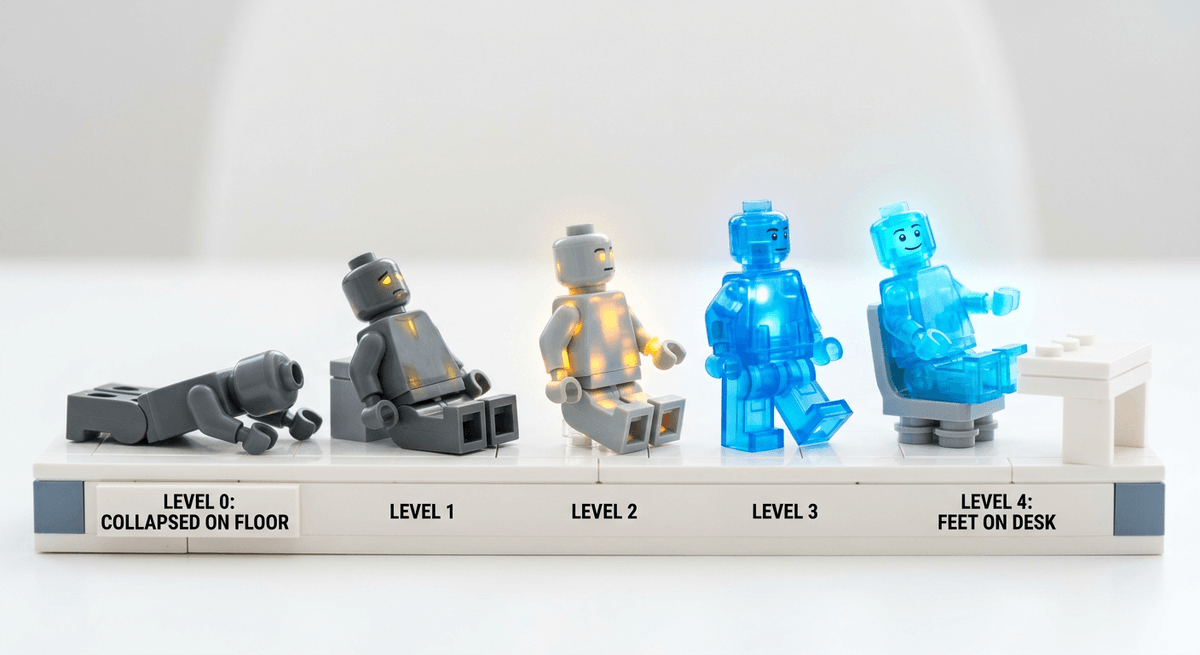
Level 0: The Purist The Purist treats the team space as a vacuum. They believe adding AI to the conversation violates psychological safety. It’s a boss fight they’ve already lost. By ignoring systemic patterns that a human brain simply isn't wired to track, they reinforce groupthink. This is where 50% of the industry currently sits.
Level 1: The Consumer The team uses AI to summarize and group. An AI background process on a Miro board identifies themes from sticky notes. It does kill the soul-crushing manual labor of grouping stickies. You actually get to spend more time talking to the humans instead of wrestling with a digital whiteboard for forty minutes.
Level 2: The Operator The Scrum Master treats Claude or Copilot as a creative partner. Before the event starts, they ask for help: "I have a team struggling with high WIP and low morale—build me a board that addresses this without being accusatory." The SM shifts from transcriptionist to architect.
Level 3: The Builder This is where things get interesting. We take board data and pair it with actual observations to find the delta between what we said and what we did. Teams at Level 3 see a 40% increase in action-item completion because they stop solving the wrong problems. It surfaces the "silent" failures humans conveniently forget to mention during the coffee break.
Level 4: The Visionary This is where I’m playing lately. It’s one step beyond the board. We feed meeting transcripts alongside those observations into the model to analyze participation balance and sentiment shifts across multiple events. It catches the systemic ghosts—the moment a concern was raised in a standup, ignored in a thread, and then completely missing from the retro board. It sees the patterns we’re too busy to track.
The Cost of Staying Level 0
Why do so many people fight to stay at Level 0? It’s usually about status. When we rely strictly on human memory to evaluate performance, we invite cognitive bias to run the meeting.
Psychologists call this "rosy retrospection." We systematically remember past events more positively than they actually happened. We edit out the friction. The engineering blog at Swarmia calls the result "fake improvements." These are action items that feel amazing in the room but have zero impact on delivery. You walk away feeling "aligned" while your pipeline is still bleeding out.
I used to be this person. I spent years thinking my "intuition" was enough. I wrote about one of those failures in The Scrum Master's Dumbest Habit (I Did It for Years). Protecting our egos from objective data is professional negligence.
The machine is just a mirror.
"90% of practitioners actually want AI to provide real-time risk detection. They know they are flying blind." That's from the Digital.ai State of Agile Report. Nine out of ten of y'all are flying blind and you know it.
The Real-Time Edge (Level 3 in Action)

The alternative to the human-only echo chamber is objective feedback.
Researchers from Personos AI and the University of Maryland recently looked at what happens when AI enters the team room. They used a system that provided real-time feedback on participation balance. The results destroy the purist argument. Teams receiving real-time AI feedback did not shut down. They actually had longer, more balanced discussions.
The AI acted as an equalizer. In search and rescue simulations, "low-potential" teams saw the biggest boost. The AI helped them get unstuck by surfacing dynamics they could not see themselves.
If the machine is a mirror, Lorie Gordon is the one holding it up. She’s not waiting for permission to be smart. She understands that human memory is flawed and, as she puts it, "AI honestly has more eyes and ears than I do."
She uses a prompt that bridges the gap: "TEAM Retro Insights, based on the past two weeks, what areas might the team want to discuss in our next team retrospective based on the team’s Kanban board: [BOARD DATA]."
She isn't asking for a summary of a chat. She is feeding the actual state of the board into the model before the meeting. She uses the AI to find the bottlenecks and flow disruptions that the team will "forget" to talk about. It’s empiricism in action.
Your Monday Dare
Most of the industry wants to stay comfortably at Level 0. They use "human-centricity" as an excuse for avoiding the hard truth of their own performance data. I challenge you to step up to that edge.
Try this Monday: Export your board from the last Sprint. Feed it into your LLM of choice before your next refinement or retrospective.
Use your enterprise-grade, private LLM instance. Don't be the person who leaks the roadmap to the public internet.
Your board data is probably messy. Feed it to the AI anyway. Ask the machine to find the gaps in your own reporting and the delta between the Sprint Goal and the actual closed tickets. That’s where the real "Edge" is. Read the output. It will highlight a blocked ticket or a workload imbalance you were prepared to ignore.
Take that insight into the room. When the team starts talking about how "good" the sprint felt, put the data on the table.
Data is that third person in the conversation who doesn't have an ulterior motive. It doesn't care about your feelings. It doesn't have a mortgage or a boss to impress. It just exists. Let the AI be the "bad guy" who points out the bottleneck so you can focus on solving it.
Stop protecting your biases. Start building real improvements.
Your move.
Continue Your Journey
AI Development for Non-Technical Builders: Move from a Level 1 Consumer to a Level 4 Visionary by creating tools that surface real team insights.
Build, Don't Generate: A strategic framework for shifting your team's mindset away from AI as a secretary and toward AI as a partner.