The Frictionless Trap: Why AI Slop is Rotting Your Communication
We killed friction in our delivery pipelines. Now AI has made communication so frictionless it's basically worthless. Learn to detect the four "code smells" of AI slop and how to refactor your orchestration for impact.

Why AI Slop is Rotting Your Communication (and How to Refactor It)
We spent ten years obsessed with killing friction in our delivery pipelines. Now, AI has made communication so frictionless it's basically worthless.
I was grabbing coffee in a hallway at Agile Open Northwest in Portland back in March 2026. I ended up chatting with Sean Olmstead about a pattern he was seeing with junior engineers. They were using AI to churn out documentation, summaries, database architecture proposals at lightspeed. The velocity looked incredible on paper.
But there was a massive catch.
The output lacked weight. It was perfectly formatted and grammatically flawless, but it didn't actually do anything. The failure wasn't the AI; it was the lack of senior mentorship. By allowing them to ship without a human-in-the-loop, the team was producing pages of text that looked like work but solved nothing. It was frictionless waste.
I've spent years in the agile trenches trying to kill friction between an idea and a customer interaction. We automated our pipelines and shortened our feedback loops. But in the era of large language models, a lack of friction is a warning sign. A big one.
When you generate content without friction, you flood your organization with zero-value slop. You rot your professional credibility.
The Bot-to-Bot Loop
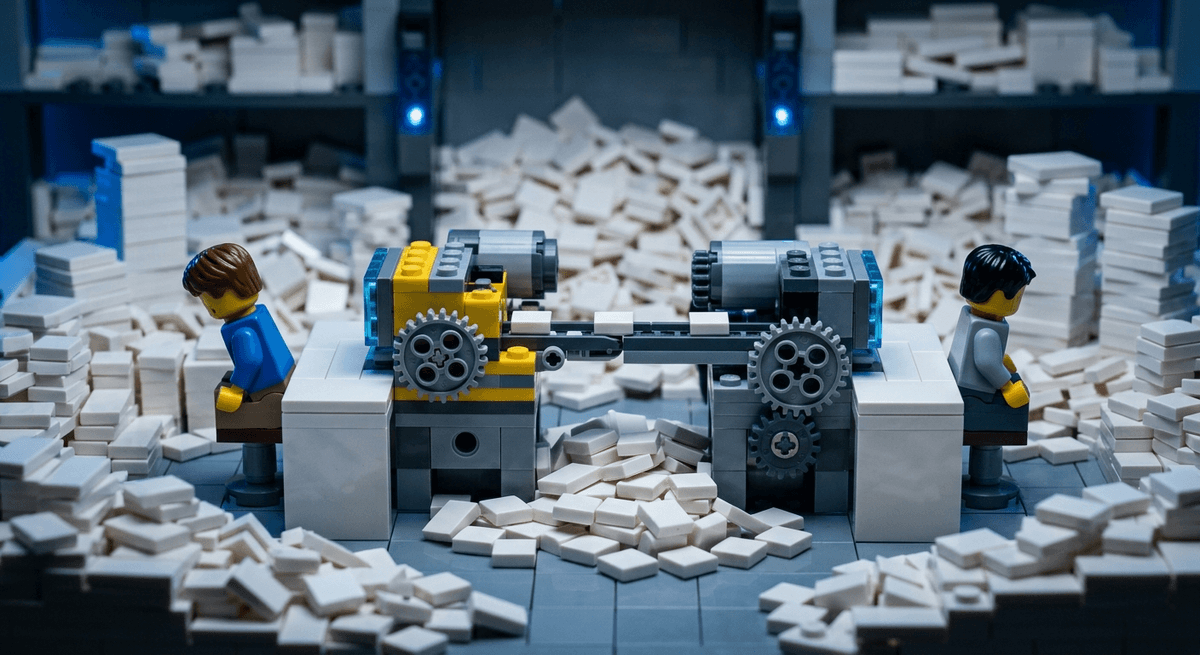
We're facing a total collapse in enterprise communication.
I’ve heard of Fortune 500s where the Slack channels are just bots talking to bots. It’s a ghost town with high activity metrics. Employees use AI to instantly generate verbose project updates, then send those updates to leaders, who use their own AI assistants to summarize the slop back down to three bullet points.
Nobody is actually thinking. Nobody is actually reading.
The data is alarming. A 2025 Bynder study found that 52% of consumers actively disengage from content the moment they suspect it's AI-generated. The moment your team smells the AI, half of them stop paying attention. You're actively repelling your audience.
You might think you're moving faster by letting the machine write your memos. You aren't. You're just typing faster. Data from practitioner circles suggests human-authored content generates significantly more engagement than raw AI output. My verdict? If it looks like a bot wrote it, people treat it like spam.
It is for this reason that I treat frictionless AI generation as a critical organizational risk. We’ve seen this pattern before in software. We call it rot.
The Diagnostic: Code Smells for AI Orchestration
Back in 1999, Kent Beck coined the term "Code Smells" while helping Martin Fowler write Refactoring. Fowler defined the concept: "[A code smell is] a surface indication that usually corresponds to a deeper problem in the system."
We need that same engineering discipline for our AI tools.
When you read an AI-generated email that uses words like "delve" or "comprehensive," the vocabulary itself isn't the bug. Those words are surface symptoms. They indicate rot. Deep, underlying rot in your prompt or your process. They prove you're stuck in "Generation Mode," the lazy reflex to hit a button and hope, vs. "Execution Mode," where we actually build with intent.
To shift into Execution Mode, you have to introduce healthy friction. You need to detect the smells and refactor the orchestration.
The Four AI Slop Smells

1. Statistical Verbosity
This is wordiness without weight. LLMs are statistically incentivized to just keep talking. They default to high formality and low lexical diversity. When an AI writes a three-paragraph intro for a simple status report, it increases cognitive load. You're taxing your stakeholders for no reason.
The Fix: Aggressive constraint. If a thought can be communicated in six words, don't accept twenty. Try this Monday: Take your longest email draft and tell the AI: "Cut this by 50% without losing the deadline or the owner."
2. Holographic Vagueness
I see this every week. Y'all might be trying to use AI for strategy, but you're just asking the machine to tell you what you already know. The text sounds profound, but it lacks substance. It feels frictionless because it never bumps into real-world constraints. No names, no dates, no trade-offs.
The Fix: Demand specifics. In my experience, specific texture keeps readers on the page twice as long as generic fluff. If the text doesn't have sharp edges, it's slop.
3. The Circular Echo
You ask the AI a question, and it spends the first two paragraphs restating your prompt. It adds zero value. It’s just a mirror reflecting your own request.
The Fix: The Orchestrator must provide new context. Feed the model raw data, customer interview transcripts, or architectural diagrams before asking it to synthesize. But be careful: there's a fine line here. You can't just throw a 500-word prompt at the problem—that's how you make everything "beige." Specificity requires intent, not just more instructions.
4. The Hollow Polish
This is the hardest smell to detect. The text is perfectly balanced, rhythmic, and sterile. It looks professional, but it feels like it was written by no one, for no one.
I sucked at this early on. I’d take whatever ChatGPT spit out just to clear my inbox. I was shipping my own brand of slop.
The Fix: Introduce burstiness. Real humans vary their sentence lengths. We use fragments. We state opinions directly. Break the smooth, sterile reading experience with a punchy verdict.
Refactoring the Slop
If you detect these smells, don't just click "regenerate." That's a lazy habit. You need to change the orchestration.
Note: These prompts aren't magic spells. They're constraints. You still have to read the output.
To kill Statistical Verbosity: Use this when you need to summarize a long thread or document without the fluff.
You are a brutal, highly efficient technical editor.

Take the following raw notes and synthesize them into a project update.
Rules:
- Maximum 150 words.
- Zero introductory or concluding paragraphs.
- Ban the words: delve, unlock, comprehensive, robust, and leverage.
- Use bullet points for any metrics or blockers.

[INSERT RAW NOTES HERE]
To kill Holographic Vagueness: Use this to force the AI to ground its abstractions in reality.
Review the following strategic proposal. It currently suffers from Holographic Vagueness.

Identify three areas where the text makes a broad claim without evidence. For each area, tell me exactly what specific data point, customer name, or architectural constraint I need to provide to you so we can rewrite it with actual texture.

[INSERT PROPOSAL HERE]
To kill The Hollow Polish: Use this when you need a draft that actually sounds like a human being wrote it.
Rewrite the following draft to eliminate AI sterility.

Rules for burstiness:
- Mix extremely short sentence fragments (3-4 words) with longer compound sentences.
- State the core opinion directly without hedging.
- Do not use semicolons.
- End the draft with a single, punchy verdict of under 8 words.

[INSERT DRAFT HERE]
The Verdict
Richness comes from rich input.
You cannot prompt-engineer your way out of a fundamentally empty thought. If you want high-signal communication, you have to do the hard work of providing context and perspective.
Do not take the first output as what you will send. Your name is on the deliverable. Claude's isn't. When your peers read your updates, they are judging your competence and your respect for their time. Stop Generating. Start Building.
Continue Your Journey
Write in Your Voice with AI: A complete pipeline for using LLMs to scale your communication without losing the texture and burstiness of your actual human voice.
Build, Don't Generate: My strategic framework for shifting your team's mindset away from mindless AI output and back toward intentional software architecture.