The Lazy Scrum Master’s Guide to Data Liberation: Why Your Jira Dashboard is a 75% Waste of Time
Rigid dashboards are a maintenance tax. Learn how to liberate your data from Jira using AI and MCP to start extracting actual insight.

The story of the Director who asked for a simple report is one where a single request threatened to eat my entire Friday. They wanted to see how our teams performed against our Service Level Expectations (SLE) over the last three release cycles. It was a reasonable request—the kind of data leadership needs to make probabilistic forecasts instead of just guessing.
I opened Jira, hovered over the search bar, and felt that familiar weight in my chest.
I said no.
Looking back, I sucked as a Scrum Master early on because I thought being helpful meant being a spreadsheet wizard. I remember a version of myself from three years ago who would have spent the next four hours manually updating start and end dates for a dozen different dashboard widgets just to keep the "status" green. It was tedious, it was soul-crushing, and it made me absolutely hate my job.
I realized I was about to pay that maintenance tax again. The data is technically "live," but the JQL is brittle. If a team changes one status in a workflow next week, the whole house of cards collapses. I wasn't acting as a leader; I was just a data janitor.
That’s theater.
The JQL Trap
Y'all feel this pain every Friday. It’s not just "one hour a sprint." It’s the cumulative weight of being a Process Clerk for a tool that doesn't love you back.
Between fixing broken automation, manually updating forms, and wrestling with UI constraints, we lose a massive amount of capacity. Let's do the math: 15 minutes of "data cleanup" a day, plus three hours of "dashboard fixing" per month. That’s a full day every month gone. Poof.
When I say your dashboard is a 75% waste of time, I’m talking about the ratio of "fiddling with the tool" versus "extracting actual insight."
Rigid plugin dashboards aren't just annoying; they’re an alarming organizational risk. You end up making high-stakes decisions on bad data because a query broke three weeks ago and nobody noticed. (And let’s be honest, half those JQL queries you wrote three months ago are probably returning garbage anyway).
If you cannot ask your data arbitrary questions without a two-hour manual workaround, you do not actually own your data. You’re just renting a view from a vendor.

The Agentic Nervous System
The fix? Decouple your data layer from your presentation layer.
Stop treating Jira as the single source of truth for visualization. Treat it as a data entry terminal. Extract the raw data. Put it somewhere you control.
I know the "Infosec Boss Fight" is the first thing y'all are thinking about. "My company will never let me pull raw Jira data into a cloud AI."
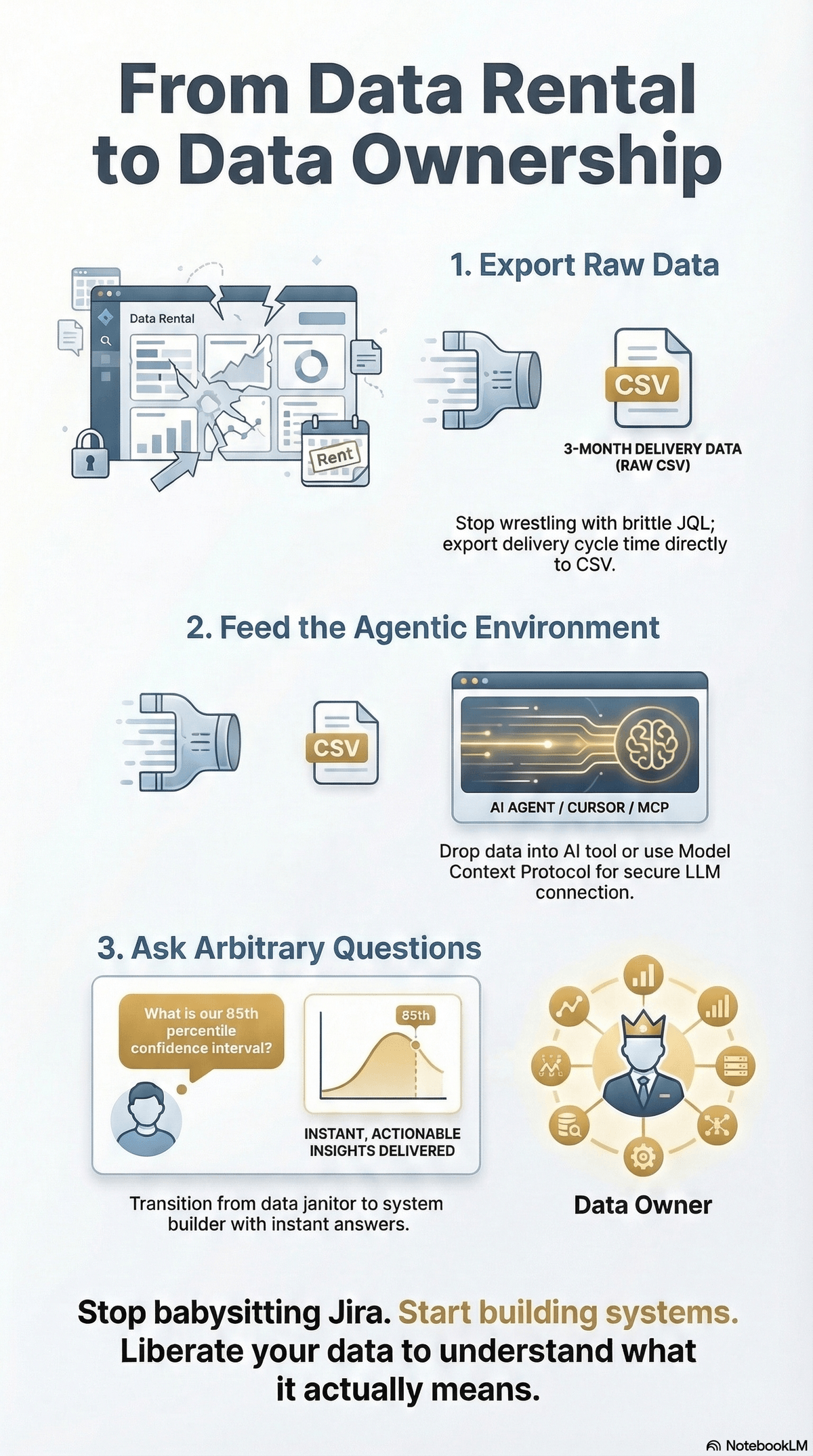
Fine. You’ve been exporting CSVs for a decade—keep doing that. Many of y'all now have access to enterprise-grade LLMs or local instances. Export your last three months of cycle time to a CSV and drop it into Claude or Cursor.
In my experience, the shift happens the moment you realize you can just ask Cursor to create new views instead of fighting JQL. I pulled the raw delivery data and fed it into an environment where I could use AI to interact with it directly.
The results were honestly a little scary. I built a custom tool that analyzed our flow metrics and cycle times without the constraints of a rigid UI. I’ve written about this speed before in The 22-Minute Prototype: How AI Changed My Definition of 'Done'.
But don't just take my word for it. Salesforce Engineering used Cursor to migrate and rebuild dashboards, handling schema mapping across 240+ complex queries. They saw a 75% reduction in time spent on the task. They turned a multi-hour chore into a 30-second function.
That is how you level up.
The Model Context Protocol
This tech isn't some future-state "maybe." It's hitting its stride right now.
Anthropic released the Model Context Protocol (MCP), and it’s becoming the connective tissue we’ve been missing. It’s a universal translator. It allows AI models to securely connect to your data sources without custom integration code for every single tool.
When you combine a local data store with MCP and an AI tool like Cursor, you create agentic memory.
Agentic memory isn't about hiding data. It's about making it instantly accessible so we can stop arguing about what the data is and start talking about what it means. I don't know if MCP will be the only standard in five years, but right now, it's winning the race.
This isn't about moving the source of truth—your auditors can keep their Jira records. This is about liberating the view of the truth. Jira keeps the records; you keep the insights.
The System Builder Mindset
Overall, you cannot effectively run Monte Carlo simulations or analyze Flow Metrics if you are trapped inside a standard, rigid dashboard. You need the raw cycle times.
When you liberate your data, your identity changes.
You stop being a Process Clerk who updates tickets and schedules meetings. You become a System Builder. You democratize the data for your entire team. Product Owners can suddenly test ideas and look at historical trends without waiting for a "Jira Expert" to write a query.
You become a force multiplier because you’ve built an environment where the data serves the humans, not the other way around.
The Monday Dare
I want you to be the "laziest" Scrum Master in the building.
Not because you don't care, but because you care too much about where your team spends its mana. If a computer can do the heavy lifting, let it.
Try this Monday:
Export your last three months of cycle time to a CSV and drop it into Claude or Cursor. Ask: "What is the 85th percentile confidence interval for our delivery?"
Then, once you see how easy that is, take the leap. Hook up the Atlassian MCP to Cursor and query your backlog directly. Ask it to find the patterns for you. Ask it to visualize the "why" behind the latest delay.
It's not as hard as it sounds, and it will push you exactly where you need to go.
Stop babysitting Jira. Start building systems.
Continue Your Journey
Build, Don't Generate: Learn the strategic mindset shift required to move from AI-generated fluff to building actual software and systems that solve real team problems.
AI Development for Non-Technical Builders: Stop waiting for developers to build your data tools. Learn how to use Cursor and AI to build your own custom dashboards and automation workflows, even if you've never written a line of code.