The Orchestrator.py Epiphany: Why Your Team's Best Hammer-Swingers Are Struggling in 2026
Adding AI makes teams 17.7% slower when managed like a 'faster hammer.' Why your best engineers are drowning and how to pivot to an orchestrator mindset.

Your team's best engineers are grinding. Hard. And they're still falling behind. Why? Because they are treating autonomous agents like a faster hammer, and they're exhausting themselves trying to keep up with the machine.
Across the industry, I see brilliant, capable professionals - Scrum Masters, delivery leads, and engineers - working differently than they ever did back in 2023. They are trying desperately to keep up with the sheer volume of output that modern tooling makes possible.
The outcome? They're drowning. They feel like they're failing and wondering if the effort is even worth it anymore.
The Way We've Been Working Crisis
We were promised that AI would make us faster. We were told it would kill the toil. But for a massive segment of knowledge workers - especially the ones who pride themselves on being the ultimate doers - the exact opposite is happening.
They are working harder than ever.
Why? Because legacy systems treat autonomous agents like a faster hammer. It’s the classic John Henry versus the steam engine story. I heard this discussed just last week at Agile Open Northwest in Portland, and it hit home. We are trying to out-swing a machine that doesn't get tired, and we're killing our teams in the process.
The data right now is alarming. A Princeton study published on arXiv shows that managing a swarm of AI agents without proper orchestration actually tanks workflows by 17.7%.
Read that again.
You add AI to your team, and you get nearly 20% slower.
This isn't just a command-and-control issue. Ask any senior engineer reviewing more pull requests than they've seen in their entire career. They are underwater. AI increases the arrival rate of work. If our departure rate - the human review - stays the same, Little's Law dictates that cycle time must increase. That is not a tooling problem. That is a physics problem.
When you apply a traditional micromanagement mindset to this, trying to verify every comma and script every move, you break the machine. You're just jacking up your own cognitive load.
That's basic queuing theory. As Joel Bancroft-Conners points out: when you plan for 100% capacity on a highway, you get a traffic jam. Push that to 120% with AI agents generating code non-stop, and you get a multi-car pileup. Everything bottlenecks until the system fails.
You're taking a tool designed for scale and throttling it down to the speed of your own exhaustion.
The Orchestrator.py Epiphany
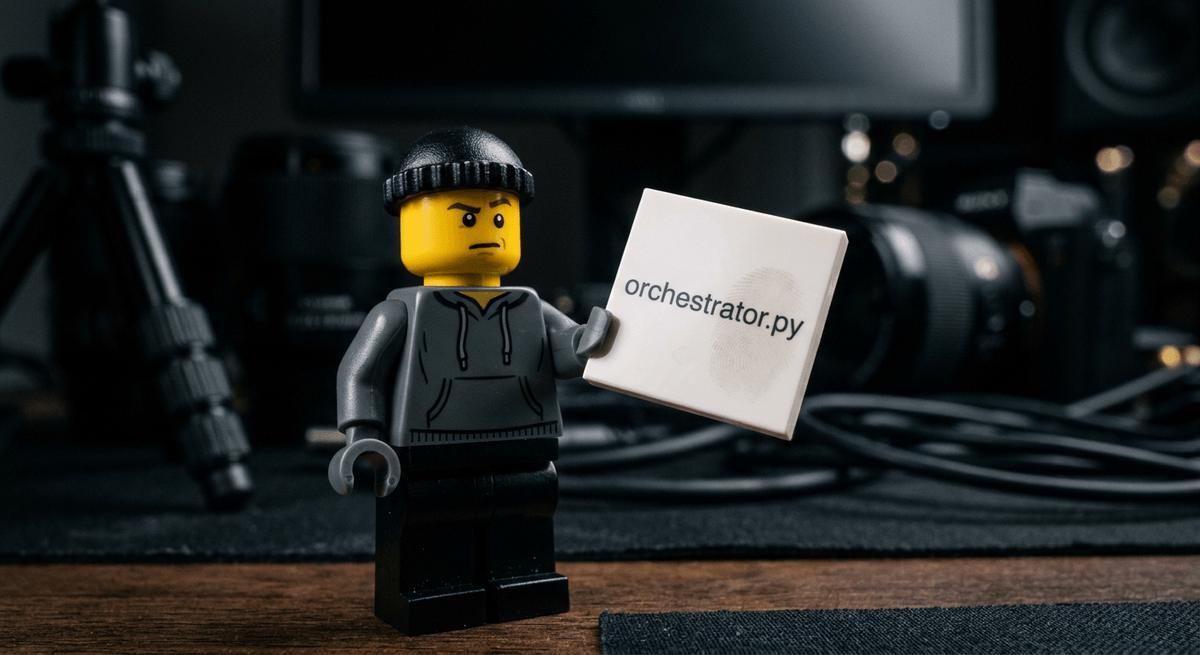
The story of my recent project with Claude Code is one where a simple filename changed how I see the world.
I was deep in the tool, trying to build a complex new feature. As a non-engineer, I quickly realized I couldn't swing the faster hammer. I had to lean into my skills as a coordinator, an orchestrator.
I kept feeding it prompts to improve the output, trying to prompt-engineer my way out of what I eventually realized was a system design problem. I'll be honest: I didn’t even understand there was a system design problem at first. I just thought I wasn't prompting hard enough.
Then I noticed a file the system had generated in the background. I didn't create it. The system did.
It was named orchestrator.py.
I just stared at that filename. It was a Matrix-code moment. That single file was doing exactly what I should have been doing: managing the boundaries, handling the state, and routing the inputs. I was down in the dirt, pouring the concrete, while the machine was trying to build the bridge.
It’s about layers of abstraction. Think about how computer languages evolved from punch cards to compilers to IDEs. We are at the next threshold.
Human language is the next programming language.
You don't see architects out there swinging hammers. At a bridge, you don't see the designers pouring concrete. In an AI-first era, doing the manual work is a trap.
The Market Has Already Decided
The industry is already pricing this shift into the market.
If you look at recent hiring data, more than 50% of open software engineering roles are now positioned above the senior level. Companies don't want to pay humans to swing hammers anymore. They want humans who can design the systems that swing the hammers.
Yet, we aren't teaching the next generation how to be orchestrators.
I've heard stories at conferences recently of engineers spending their entire day going back and forth with their AI, modifying plans instead of modifying files. That is the shift. When teams move from manual execution to system orchestration, the dynamic changes. You adopt a new identity as an architect who designs the flow of value.
I've been tracking these failure patterns, and the root cause is always identity. This hits Agile Coaches and delivery leads hard. The Scrum Master who insists on manually running every conversation and every event like they did five years ago is just another hammer-swinger. That's theater.
Even Scrum.org is waving the flag, noting that AI-aware practitioners must use agents to build these tools into the way they work. Tactical prompt engineering is dying. Strategic architectural design is taking its place.
Designing the Bridge

We have to fundamentally change how we interact with the work. We need the Orchestrator Mindset.
The magic happens when you stop focusing on the how and start focusing on the what and the why. When you provide enough why, the system - whether human or agentic - will figure out the how. We have known this for years.
Your job is no longer to write every line or draft every report. As coaches and Scrum Masters, our focus shifts to defining the boundaries and providing clear context.
You are the architect of clarity.
When you act as an orchestrator, you stop asking "what did you do yesterday?" That is legacy thinking. Instead, you ask:
- What outcomes did you have yesterday?
- What blockers did you experience?
- What learnings did you have?
Y'all, we have to share what we're learning right now. These systems are evolving rapidly because everything is the system. The way we work is changing every single week.
(This is terrifying for many of us, by the way, but not me. And not many of the people I interact with who follow this journey.)
It requires a massive surrender of ego. You have to accept that your value is no longer tied to the physical output of your hands. Agile is more true than ever. It has always been about getting out of the way and working yourself out of a job. You’re just doing it in a new way now.
And you know what happens when you work yourself out of a job? You work yourself into a new one. You move to a new layer of problems.
Don't mourn what was. Embrace what is.
The Monday Dare
So here is my challenge to you.
Next time you face a problem - whether you are writing a script, planning a sprint, or building a feature - stop yourself. Take your hands off the keyboard.
Ask yourself: Am I swinging a hammer right now? Or am I designing a bridge?
We're all moving toward this orchestrator mindset. If you stick with command and control, you're going to struggle as we move into the AI-first era.
Stop pouring concrete. Start designing the system.
Your move.
Continue Your Journey
AI Development for Non-Technical Builders: Stop trying to prompt-engineer your way out of system design problems and start building actual orchestration layers.
Build, Don't Generate: My complete framework for moving past the "faster hammer" mindset and designing software that actually scales.