The Invisible 'No': Why Your LinkedIn Feed is Lying to You About Success
My conference rejection rate is 70%, and it's a personal best. Behind the 'Accepted' badges is a graveyard of failure I usually keep hidden. Here is why your LinkedIn feed is lying to you.

My conference rejection rate is 70%. It is, quite literally, a personal best.
Behind every "Accepted" badge y'all see on LinkedIn is a graveyard of failures I usually keep hidden. I have three confirmed speaking slots for 2026. They’re shiny, prestigious, and a total distraction. The real story is in the red markers on my dashboard: 42 pitches I sweated over that ended in a "No."
Below those three green entries is a list of missed opportunities. Agile on the Beach. DevOps Days Atlanta. Lean Agile Cambridge. Each one represents hours of preparation and an email that gutted my Tuesday afternoon.
The version of my life you see on the feed is a lie of omission. For every "Accepted" badge I post, seven "No thank you" emails are sitting in my archive.
I recently received a rejection that stung. I had done a virtual talk for this specific conference before, and the organizer personally encouraged me to apply again. I thought I was a shoo-in. (I wasn't.) Looking back, I was lazy. I relied on a relationship instead of the value, and the committee saw right through it. They were right to say no.
I didn’t pivot. I just moved to the next row in the spreadsheet, tweaked the abstract, and hit submit again. Stoic? Maybe. Mostly just stubborn.
The feed is a lie. The math tells the truth.
You see the wins, the podcast appearances, and the keynote announcements. You don't see the dozens of rejections required to secure a single "yes." We’re drowning in a sanitized version of reality. It’s a highlight reel that makes brilliant practitioners feel like they’re standing still while everyone else is sprinting.
The Biology of a Crushing Email
We need to talk about the physical toll of this filtered reality.
This isn't about "feelings." It's biology. Neuroscience shows the brain doesn't distinguish between a social "no" and a physical blow. It’s a literal threat response. You log onto LinkedIn and see five peers announcing talks while your inbox is empty, and your brain starts looking for the exit. You assume you’re obsolete. You assume your material is garbage. You start questioning if you ever knew what you were doing. It's exhausting (and we all do it).
I remember an email in late 2024 telling me I would not be speaking at the Global Scrum Gathering 2025. It hurt. I questioned my own experience. But that rejection was the spark I needed to sharpen my message. I finally got the "yes" for the 2026 Gathering because I stopped expecting the industry to hand me a microphone.
Here is the math: I've heard stats for one conference—1,500 humans fighting for 60 slots. That’s a 4% acceptance rate. Committees are just humans in a room. They gravitate toward known quantities when the volume hits 1,000+. It’s not malice; it’s a heuristic for risk. Organizers have a fiduciary responsibility to fill seats and a social responsibility for diversity. It's a balancing act where "great" often loses to "safe."
Volume and quality of submission are the only levers you actually control.
Maybe you don’t want to be on a stage. Fine. But you’re still pitching a new WIP limit to a skeptical VP, or trying to get a team to adopt a tool that actually works. The rejection math is the same. When you show your team your "red markers," you give them permission to fail. You're building psychological safety by being the first one to bleed.
The CV of Failures
In 2016, Johannes Haushofer, a professor at Princeton, published a "CV of Failures." He listed every rejected degree program, every denied academic position, and every research grant that refused to fund him.
The document went viral because people are tired of the polish. We are exhausted by the perfection of the digital age. Haushofer proved that the most powerful thing a leader can do is expose their own messy reality.
I refuse to hide my red entries anymore. I recently told Erik Collard:
"I get a lot of rejections which makes the acceptances so much sweeter. Sometimes I get sad when I keep getting rejected, but it is what I want to do and I keep doing it. Heck, if I didn't, then I would have never met you."
That is the actual job. The expertise is not in the acceptance. The expertise is in surviving the failure rate that makes everyone else quit.
The Resilience Portfolio

As a coach, I spend a lot of time helping people learn how to say no to protect a sustainable pace. We reframe "no" from a rejection into a mechanism for focus.
But we rarely apply this to the "nos" we receive.
You need a system for tracking your rejections. Not to dwell on them, but to prove you are doing the work. If you do not have a massive list of rejections, you are playing it safe.
Every red entry in my app is a data point. As Michael Jordan said, you miss 100% of the shots you don't take. It's a cliché for a reason. The most successful thought leaders in our space are not the ones with the highest win rate. They are the ones with the highest volume of attempts.
Once you see the math, the sting fades. Y'all, it stops being a verdict on your soul and starts being a line item in your budget.
Stop Polishing. Start Failing.
Stop looking at LinkedIn as a mirror. It is a highlight reel.
Every person you admire has a hidden folder full of crushing emails. Every keynote speaker you watch has bombed a pitch. The only difference is they did not let the failure rate stop them from submitting the next CFP.
We need to normalize the messy reality of experimentation. If we want our community to be a place of growth, we have to model what failure looks like. We cannot build a real professional network while we curate an image of absolute perfection.
Try this Monday: Open your notebook. Write down the last three professional rejections you received. A passed-over promotion. A rejected budget request. A client who went with another consultancy. Look at them. Acknowledge the sting.
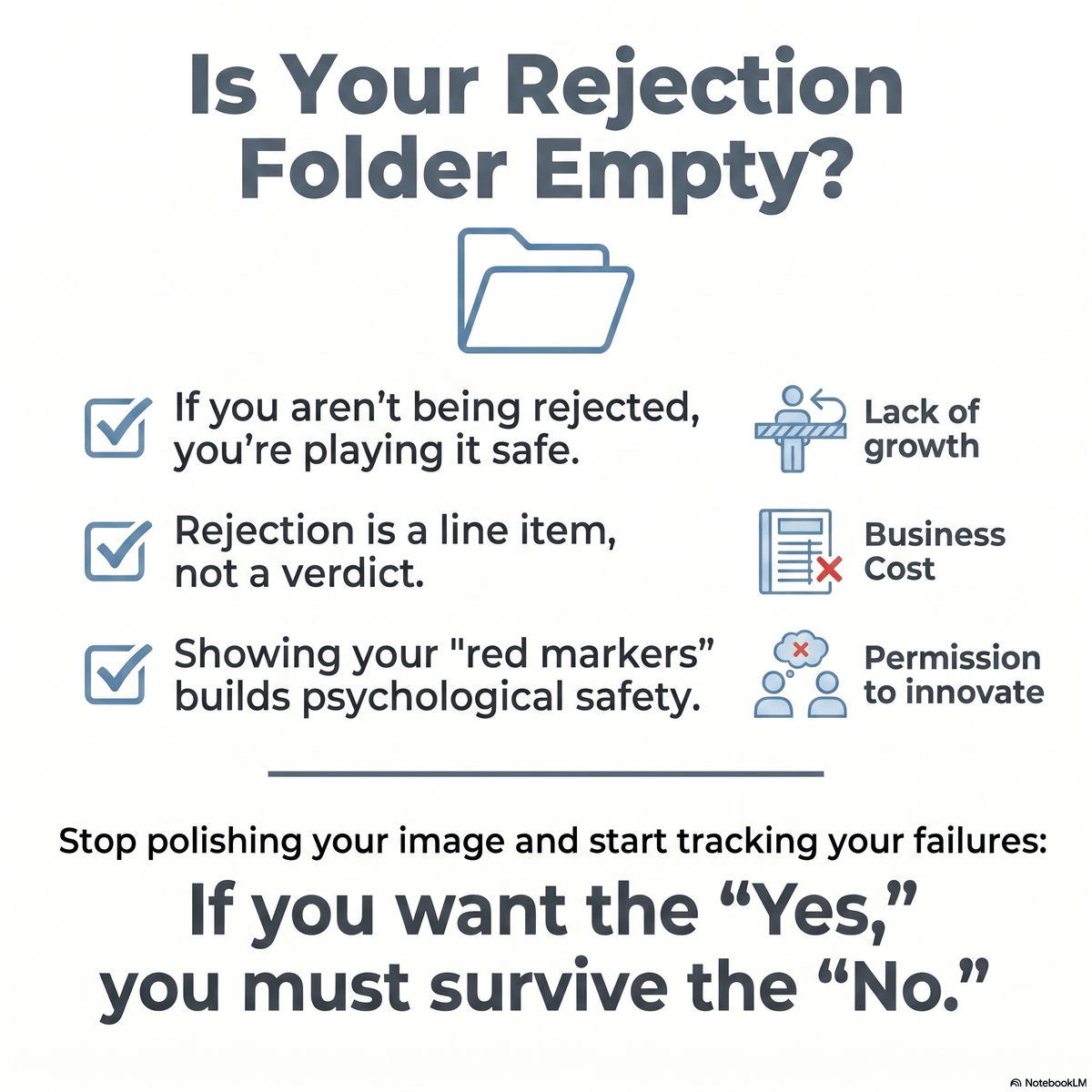
Then, share one of them. Post it to a Slack channel, a peer, or your team. Kill the shame of the "No" by saying it out loud. When you're the first one to show your "red markers," you give everyone else the space to be human. Remember those 42 red markers on my dashboard? They are the only reason the 3 green ones exist.
Now go get rejected.
Continue Your Journey
Speaking & Keynotes: Want to hear the talks that actually survived the 93% rejection rate? Let's bring these conversations directly to your organization.
Free Resources Hub: Access the templates, calculators, and tools I use to navigate the messy reality of agile delivery.