Why AI-First Companies Are Failing: The Agility Gap Nobody's Talking About
42% of AI initiatives abandoned in 2025. The missing ingredient isn't better algorithms.

Forty-two percent.
That’s the share of companies that abandoned most of their AI initiatives in 2025, according to S&P Global. Not paused. Not deprioritized. Abandoned. And here’s the part that should terrify anyone with AI on their roadmap: that’s up from 17% just one year earlier.
Subscribe
We’re not getting better at this. We’re getting worse.
The Question Nobody’s Asking
What frustrates me about the current AI discourse: everyone’s talking about models. Compute power. Data pipelines. Context windows. The conversation has become so technically sophisticated that we’ve completely missed the obvious.
Why are the organizations with the deepest pockets and smartest people failing at such alarming rates?
I’ve got a theory. Y’all aren’t going to like it.
The problem isn’t the AI. Most organizations haven’t built the muscle to adapt quickly, fail safely, and pivot when reality doesn’t match the plan. They can’t iterate. They can’t learn. They can’t course-correct at the speed AI demands.
That muscle has a name. It’s called agility.
And it might be the most undervalued prerequisite for AI success that exists right now.
What the Data Actually Shows
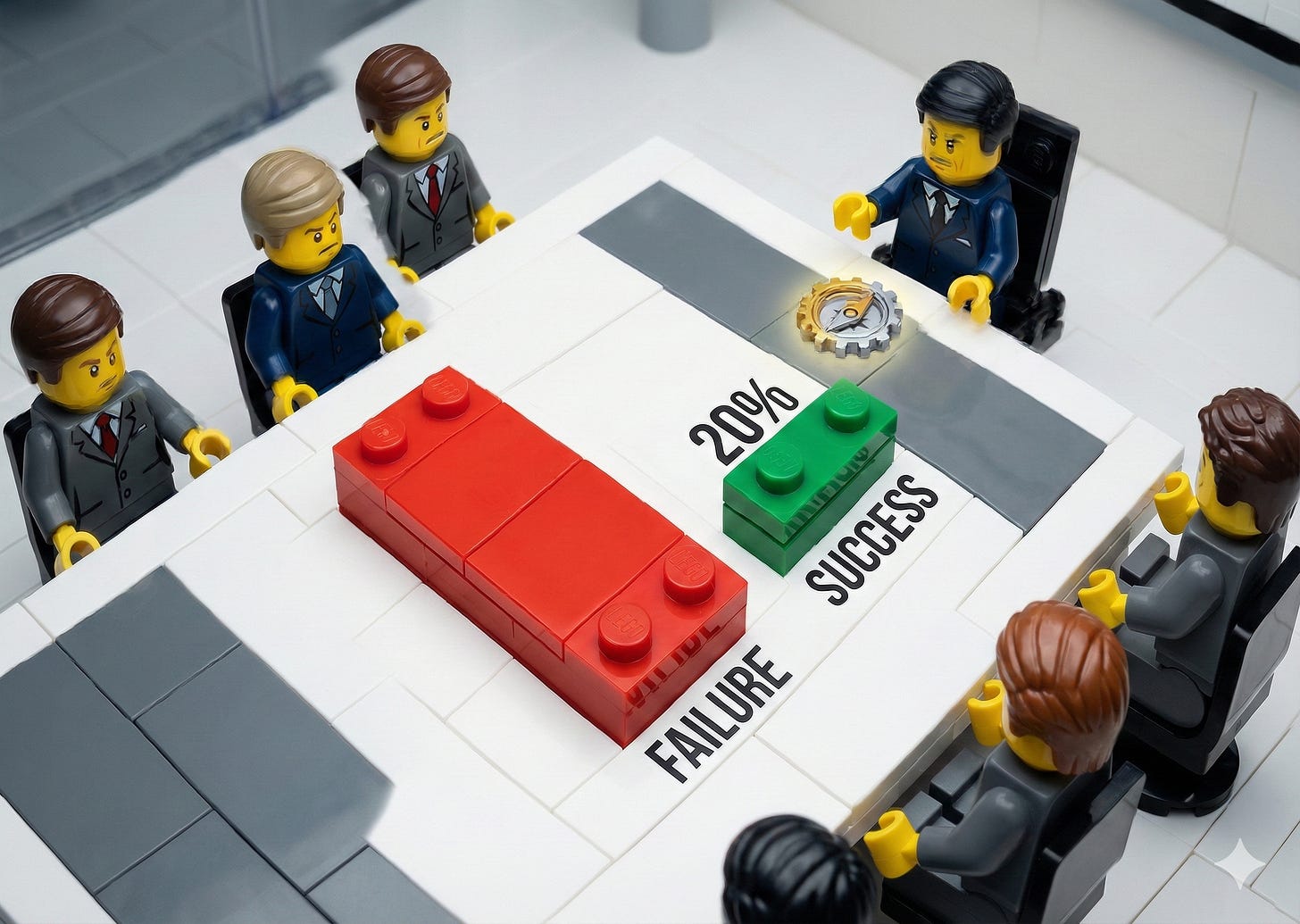
Let me walk y’all through what we know - and what we should be skeptical about.
RAND Corporation found that more than 80% of AI projects fail. That’s double the failure rate of traditional IT projects. Now, that study is a few years old - and here’s the thing:
AI is the worst it will ever be today.
Tools that felt impossible last quarter ship as standard features next month. But even accounting for rapid improvement, the pattern holds: we’ve been doing IT transformations for decades, gotten reasonably competent at them, and somehow AI fails at twice the rate.
(You’ll see sources citing even higher numbers - 95% failure rates for GenAI pilots. Take those with a grain of salt. The methodology behind some of these headlines relies on small sample sizes, cherry-picked interviews, and definitions of “failure” that mean “no immediate P&L impact within six months.” That’s not failure - that’s learning. The 80% RAND figure, based on interviews with 65 experienced data scientists and engineers, is more defensible.)
The S&P Global numbers tell a clearer story: 42% of companies abandoned most of their AI initiatives in 2025, up from 17% just one year earlier. Not a correction. A collapse. Organizations scrapped 46% of their AI proof-of-concepts before reaching production. They aren’t walking away from AI - they’re walking away and starting over. And again. And again. Hoping they’ll somehow get it right next time without changing what made them fail in the first place.
But the stat that stopped me cold came from Boston Consulting Group: 70% of AI implementation challenges stem from people and process issues, not technology.
Seventy percent. People and process.
Not data quality (though that matters). Not compute infrastructure (though that’s expensive). Not model selection (though that’s complicated). Seven out of ten problems trace back to humans - to how organizations make decisions, share information, respond to failure, and adapt to change.
Every single one of those failure modes is something agile practices directly address. Iterative development. Continuous feedback. Cross-functional collaboration. Starting with the problem, not the solution.
The Scrum Alliance Pivot Worth Watching
I’ve been reading through Scrum Alliance’s 2025 Annual Report, and something interesting caught my attention.
Their 2026 strategy positions agility explicitly as “the foundation for AI.” Not a competing approach. Not an alternative. The prerequisite.
Here’s their framing: “The coming year will center on helping professionals and enterprises build the capabilities to respond to anything that comes their way - whether that means making AI an essential part of their strategy, adapting to new competition, or upskilling their teams.”
They’re not defending agile against AI. They’re arguing you can’t do AI without it.
Significant shift.
I’ll be honest - I spent years teaching and talking about how AI would eventually free me from the mundane parts of my Scrum Master work. (I had a talk in 2024 called Masterless Scrum that was specifically about AI in Agile Teams.) Turns out that’s exactly what’s happening. The repetitive stuff - status tracking, meeting scheduling, note synthesis - gets automated. What remains is the irreducibly human work: reading a room, sensing when a team is stuck, speaking truth to power. AI isn’t replacing that. It’s creating more space for it.
Why This Matters for You
If you’re a Scrum Master, agile coach, or team lead, I have good news and challenging news.
The good news: your skills are becoming more valuable, not less. The organizations fumbling AI adoption are the ones that skipped the fundamentals. They wanted the shiny new thing without building the foundation to support it.
The challenging news: you need to make the connection explicit. Executives don’t naturally see “we need to improve our retrospectives” as “we need to build AI readiness.” You have to translate.
Here’s how I’d start framing it:
When they say: “We need to move faster on AI”You say: “What’s our current cycle time from idea to production? That’s our AI speed limit.”
When they say: “Our AI pilots keep stalling”You say: “What’s our governance approval process look like? AI initiatives die in governance, not in execution.”
When they say: “We need AI training for the team”You say: “AI changes almost monthly. We need to give people room to explore and experiment - the meta-skill is learning how to learn.”
Real Agility vs. Agile Theater
I’m not here to defend bad implementations. There’s plenty of agile theater out there. Consultants selling events. Coaches more focused on compliance than outcomes. Organizations “doing agile” by renaming their status meetings and calling them daily scrums. That criticism is fair.
But the core principles of agility - iterating quickly, responding to change, valuing people over process - aren’t dead. They’re being validated by every failed AI transformation.
GE Digital poured billions into becoming a software company. They brought in AI. They brought in machine learning. They spread resources too thin, underestimated cultural change, and lacked the organizational agility to iterate. The result? A cautionary tale that cost shareholders billions and set the company back years. The technology wasn’t the problem. The inability to adapt was.
Organizations that can’t adapt quickly are failing at AI. Full stop. The methodology police can debate whether they’re called daily standups or syncs, but the underlying capability - building teams that learn and pivot fast - is exactly what AI adoption demands.
The question isn’t relevance. It’s whether you’re practicing real agility or performing it.
What to Do Monday Morning
- Audit your feedback loops. How long does it take from “we tried something” to “we learned whether it worked”? If it’s measured in months, AI will crush you. Get it to weeks. Then days.
- Let AI attend your meetings. My friend Dan Puckett from the Agile Moose Herd turned me on to this: skip the large status meetings entirely. Teams already captures the transcript - afterward, just ask Copilot something like “I’m the PO for X, I’m interested in Y - what from this meeting was relevant to me?” Presto. Time saved, insights gained, and you were never in the room.
- Start measuring cycle time if you aren’t already. Not velocity. Not story points. Cycle time - from idea to customer reaction. Understanding your actual flow gives you honest feedback about whether changes are working.
- Reframe your value prop. You’re not teaching Scrum events. You’re helping teams work better together, delivering more. Next time someone asks what you do, try that. The AI context makes that translation easier than ever.
The irony is almost too perfect: the organizations racing toward AI without building agile foundations are failing at exactly the rate you’d predict. The ones who invested in adaptive capacity - in real agility, not just the events - are the ones successfully integrating new tools.
Stop chasing AI readiness assessments. Start building teams that can adapt to anything.
Bring it on. I’m ready.
Continue Your Journey
AI Development for Non-Technical Builders: Learn how to build real AI-powered tools without a computer science degree - focused on practical implementation, not theory.