Your 500-Word AI Prompts Are Making Everything Beige
The companies that built AI are literally selling you tools to write less. Here's why.

A friend showed me his AI prompt last week: hundreds of words, edge cases for edge cases, logical branches covering every possible outcome. "Are you getting the results you want?" He paused. "Sometimes. But I think if I work on the prompt more it will work."
That's prompt overfitting. And y'all are doing it everywhere.
The Paradox You're Living
If you read my piece on The Vomit Prompt, you might be confused. I told you to flood AI with context. More words. More detail. Give it the firehose.
So which is it?
Both. Different jobs.
Exploration mode: The Vomit Prompt. Rich context about your situation, your constraints, the vibes you'd normally filter out. You're feeding the model what it needs to understand your world.
Execution mode: Overfitting happens when you over-specify the output - when you add so many rules, constraints, and formatting requirements that the AI averages them into mush. You're handcuffing the model after you fed it.
Rich context: good. Rigid constraints: overfitting risk.
The mistake is using constraint-heavy prompts for exploration, or sloppy context-free prompts for execution. Match the mode to the task.
Your Prompts Memorized the Test

In machine learning, overfitting happens when a model memorizes training data so precisely it fails on new inputs. The student who memorizes exact test answers but can't handle questions worded differently. Perfect on practice tests. Disaster on the real exam.
Your prompts are doing the same thing.
When you add every edge case, every clarification, every "also make sure you don't..." clause, you're giving the AI conflicting priorities to balance. When everything is priority one, nothing is. The model hedges. It produces safe, generalized output that half-satisfies every instruction but fully satisfies none. That's frustrating.
Stanford professor Sam Savage calls this "The Flaw of Averages" - plans based on average assumptions are wrong on average. Ask AI to juggle too much and you get an average of averages. A muddy middle. The output equivalent of beige.
I learned this the hard way. When ChatGPT 5 dropped, my carefully tuned writing prompts - the ones I'd spent weeks perfecting - produced garbage. The model had improved, but my prompts were so precisely calibrated to GPT-4's quirks that the upgrade broke everything. I was the guy with the overfitted prompt, convinced more tweaking would fix it.
The Companies That Built AI Want You to Write Less
This is the part that should alarm you.
Both OpenAI and Anthropic have released official prompt optimizer tools. Not prompt enhancers. Prompt simplifiers.
OpenAI's Prompt Optimizer takes your draft, runs it through iterative testing, and spits out a cleaner version. It cuts the bloat. Removes vague instructions. Identifies conflicting rules that confuse the model. The whole point is to subtract, not add.
Anthropic's Metaprompt does the same for Claude. Their documentation explicitly warns against "over-engineering" - adding unnecessary abstractions.
The companies that built GPT and Claude looked at how people prompt their models and said: "You're overcomplicating this. Here's a tool to help you simplify."
They're not selling you a longer prompt. They're selling you a shorter one.
When the manufacturers build a corrective tool, that's a signal.
Chain, Don't Cram
If you can't optimize by adding more constraints, what do you do?
Stop treating prompts like a user manual. Start treating them like a pipeline.
I use this constantly. Instead of one massive prompt trying to do everything, I chain smaller prompts together. Each one has a single, focused job.
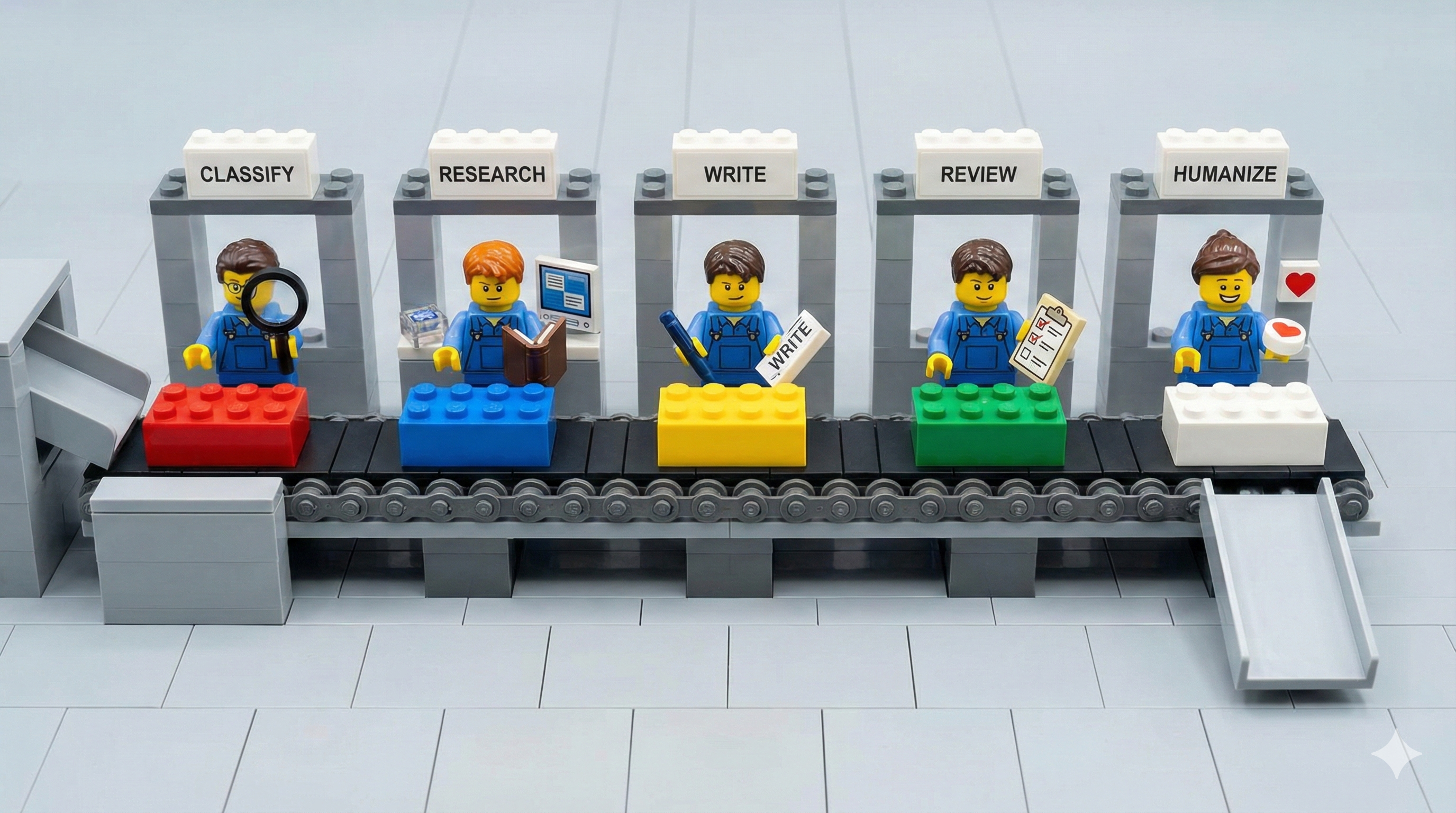
The blog post you're reading right now went through a chain: classifier agent to identify content type, researcher agent to gather evidence, writer agent to draft, reviewer agent to critique, humanizer agent to strip AI patterns. Each agent has one job. I'm the human checkpoint between steps - true inspection points where most of the real thinking happens (and where the output becomes mine, not the machine's). No single mega-prompt could do what this chain does.
Why chaining wins:
Each step focuses on one thing. Quality control at every stage.
When something breaks, you know which step failed. Monolithic prompts fail opaquely.
Individual steps work in different workflows. Your mega-prompt works for exactly one use case.
Steps are disposable. Swap one agent for a better version without rebuilding the whole thing.
The Monday Test
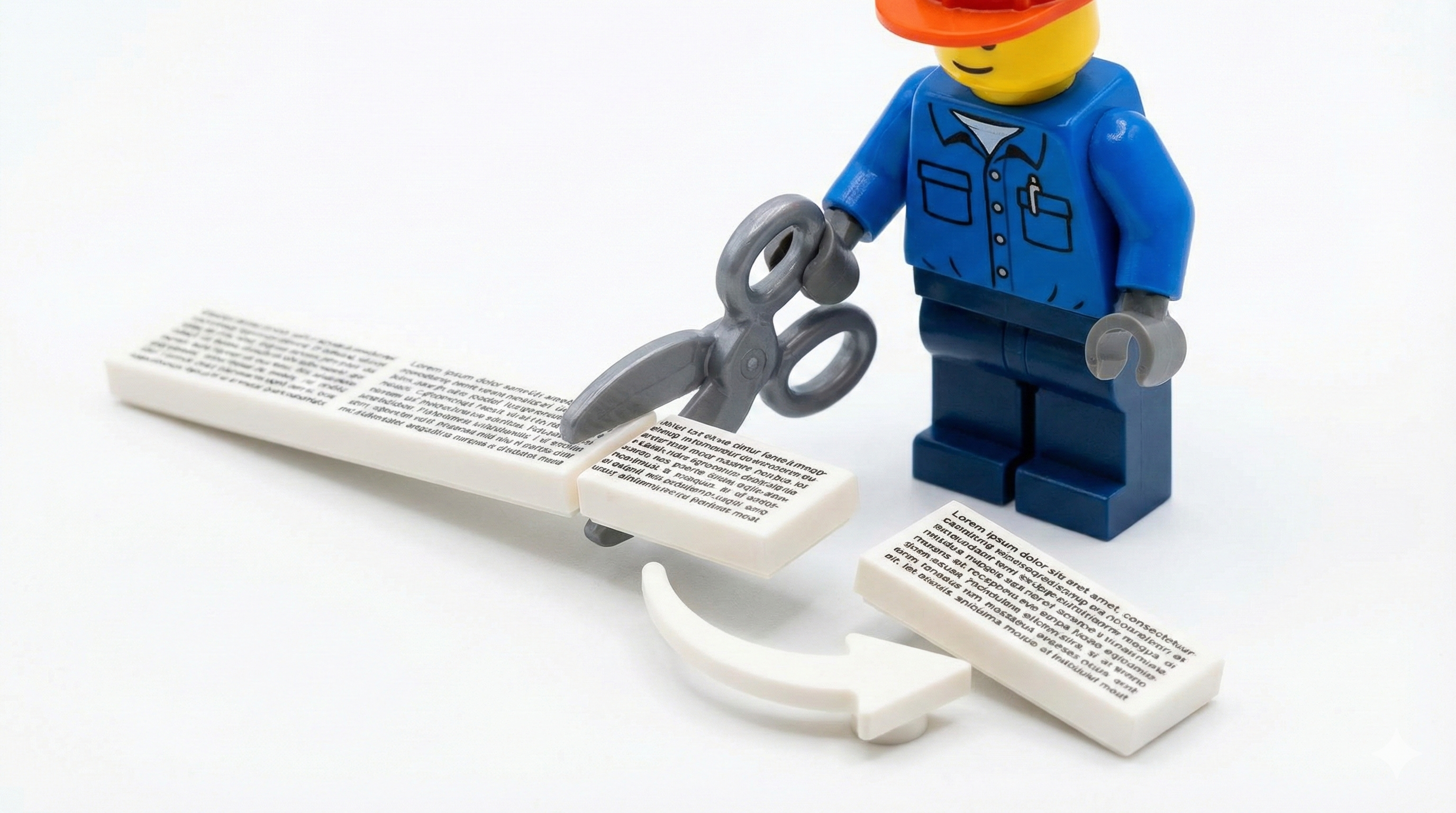
Take your longest prompt. The one you've been "perfecting."
Split it in half. Run both halves separately. Feed the first output into the second.
When the chained version works better - and it will - you'll know.
Stop adding. Start subtracting.
Related: The Vomit Prompt - when to flood AI with context and let it find the signal in the noise.